Pages

Showing posts with label model railroading. Show all posts

Thursday, April 01, 2021

RECENT TWEAKS to the PLYWOOD EMPIRE ROUTE

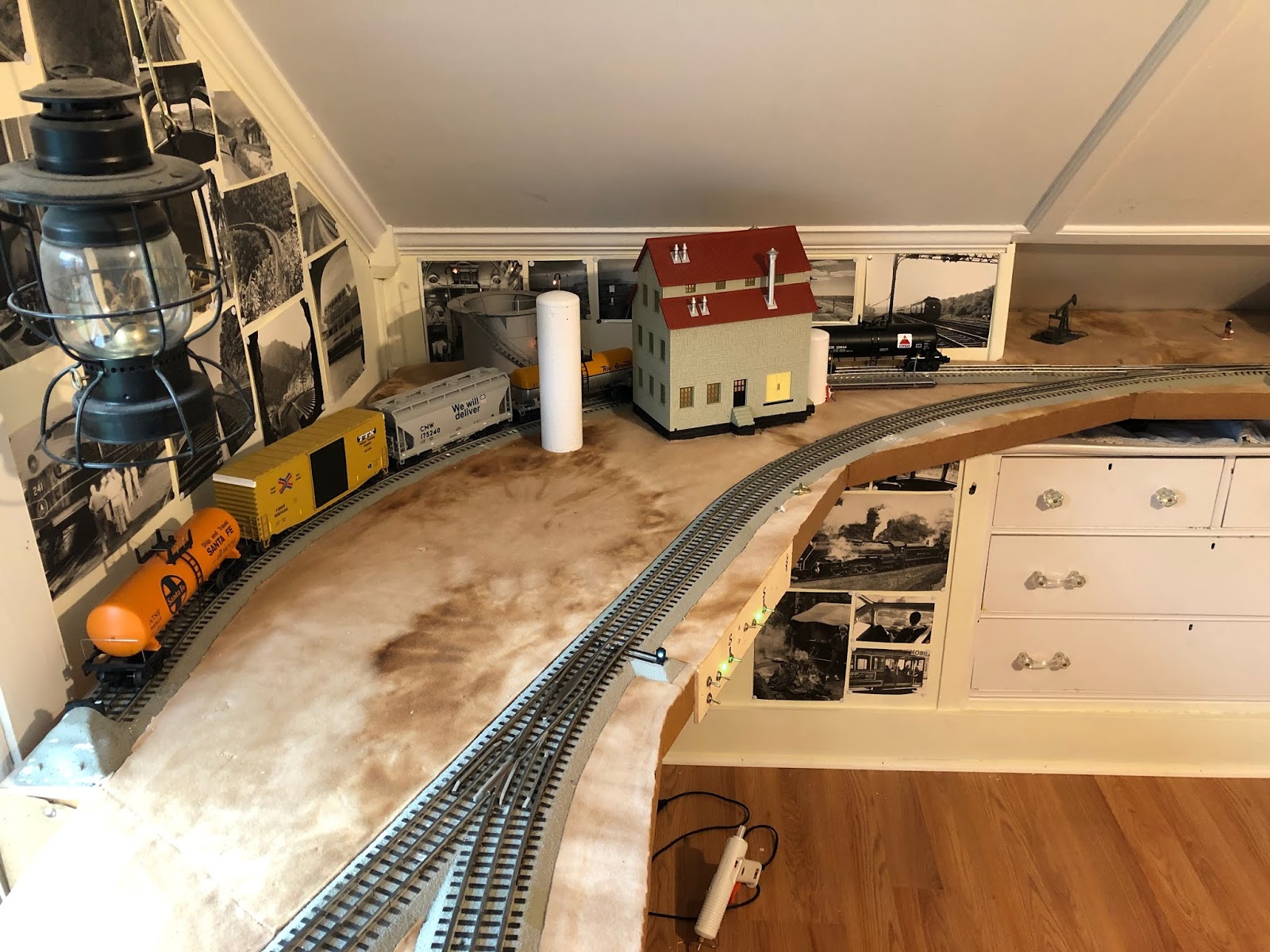
The elimination of one siding simplified East End trackwork without detracting from operation. I had to cut down the mountain a bit and move Oil Creek a bit (again) in order to lengthen one of the remaining two sidings (to provide adequate space for switching) but I'm pleased with the result, both esthetically and operationally.


This siding was eliminated:


Overall view now. 
The control panel on the facia operates the
 Scrapyard Lionel Electromagnetic
traveling Gantry Crane.


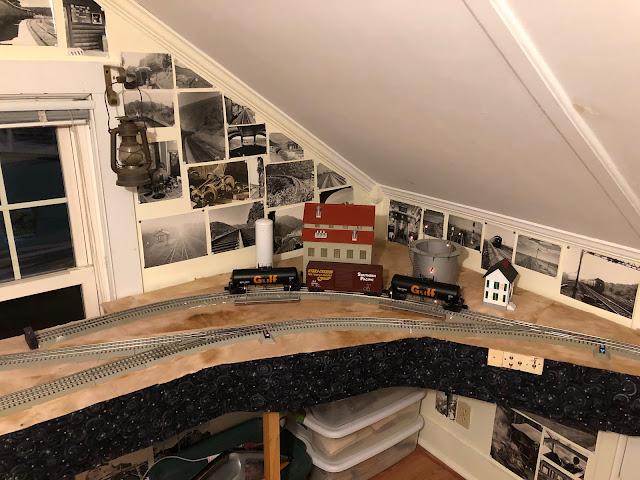
There are four customer spots, three in this pic.
Rear left to right the Buckwheat granary,
and a tank rack for the Sunoco fuel oil dealer.
In foreground is the Scrapyard siding
which has switching space for six cars. In this pic
the orange covered hopper is being stored off-spot 
and the Mill Gon is being loaded with scrap steel.


The fourth customer car spot is at the end of
the scrapyard siding. I need to add a building flat
 loading dock there for a boxcar.


The bridge over Oil Creek.


I like the forced perspective in the foreground photo.


Looking South from the mountainside above the tunnel.
That tower is a leftover from
a busy past when this railroad
was a Mainline.


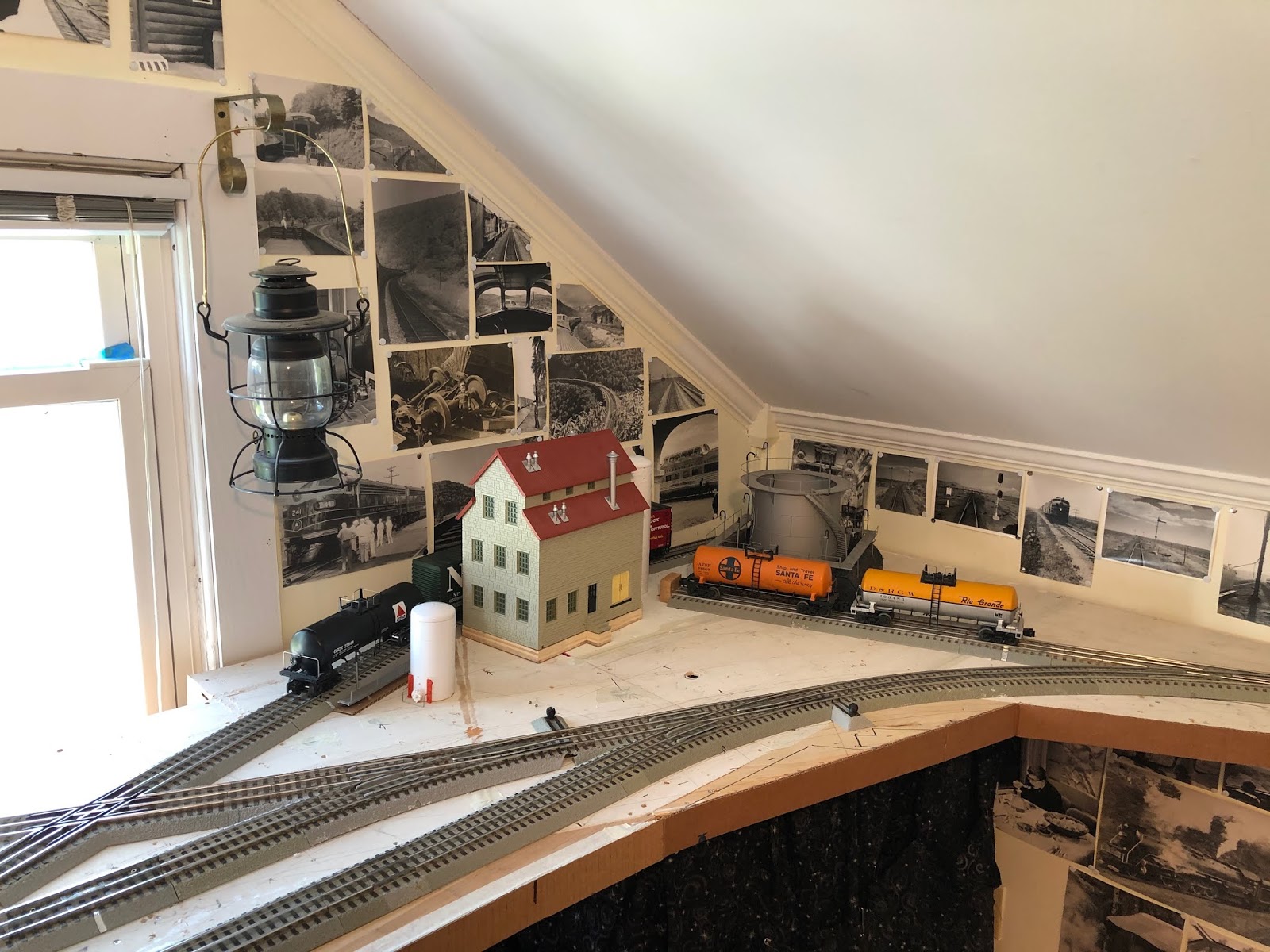
The West End siding has three customer car spots at the Paint Factory,  a [resin] tank rack, a [boxcar] loading dock and a spot for a covered hopper of titanium dioxide pigment. Space is available for storage of two more cars.


Interesting and satisfying Operation on the Plywood Empire Route is now implemented with just three track switches. A fourth switch (hidden beneath the mountain) is only necessary to create a closed-loop for continuous running. 


Friday, November 06, 2020

Speaking of Balance

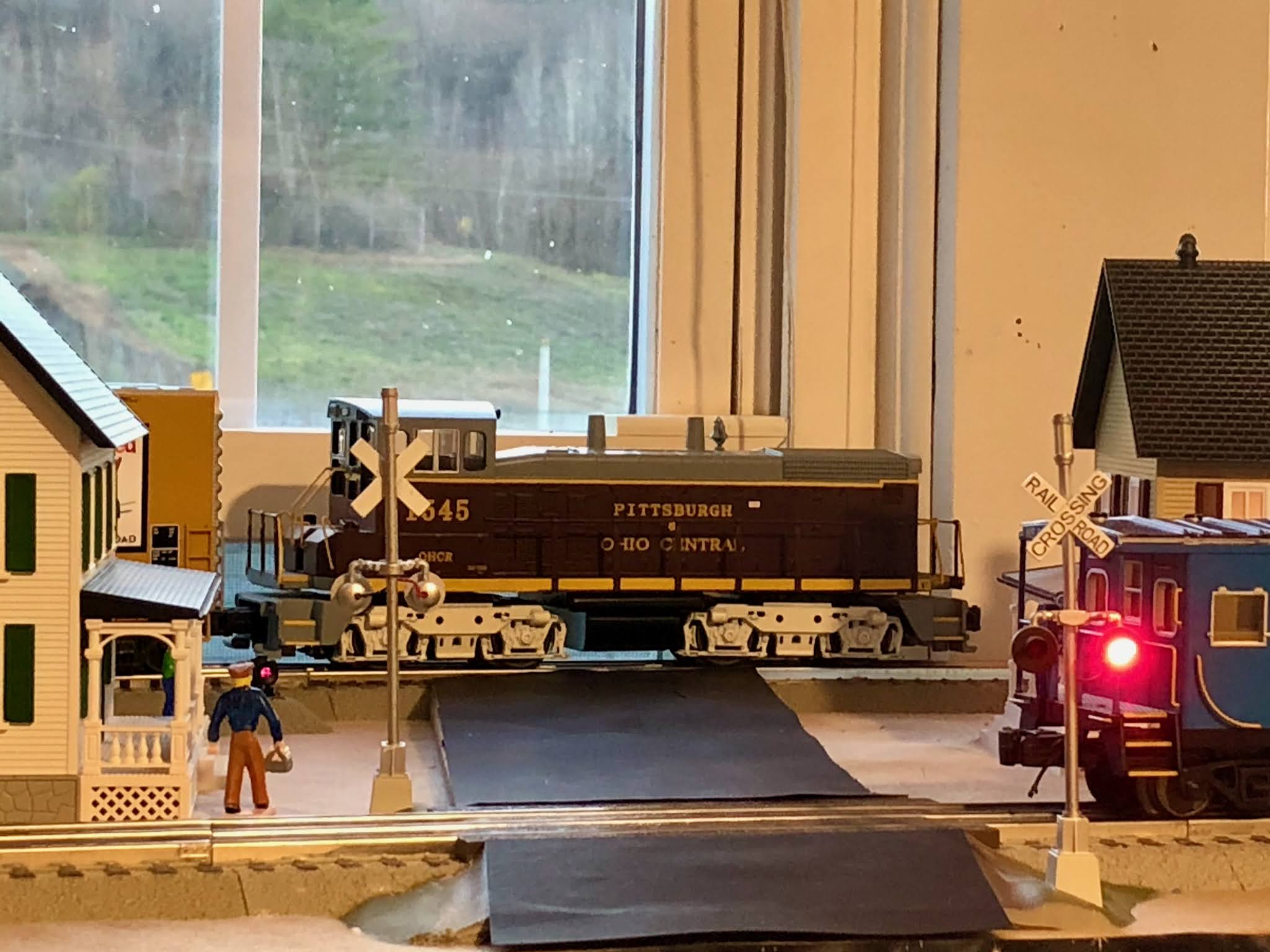
 Front and center just hasn't been right. Too spartan, empty even. "Town" doesn't seem to fit. So I went to work and rearranged some bits. I replaced the Depot with two houses, a street and a Grade Crossing and wa la, it came together into a scene:


Drama!


Balance:


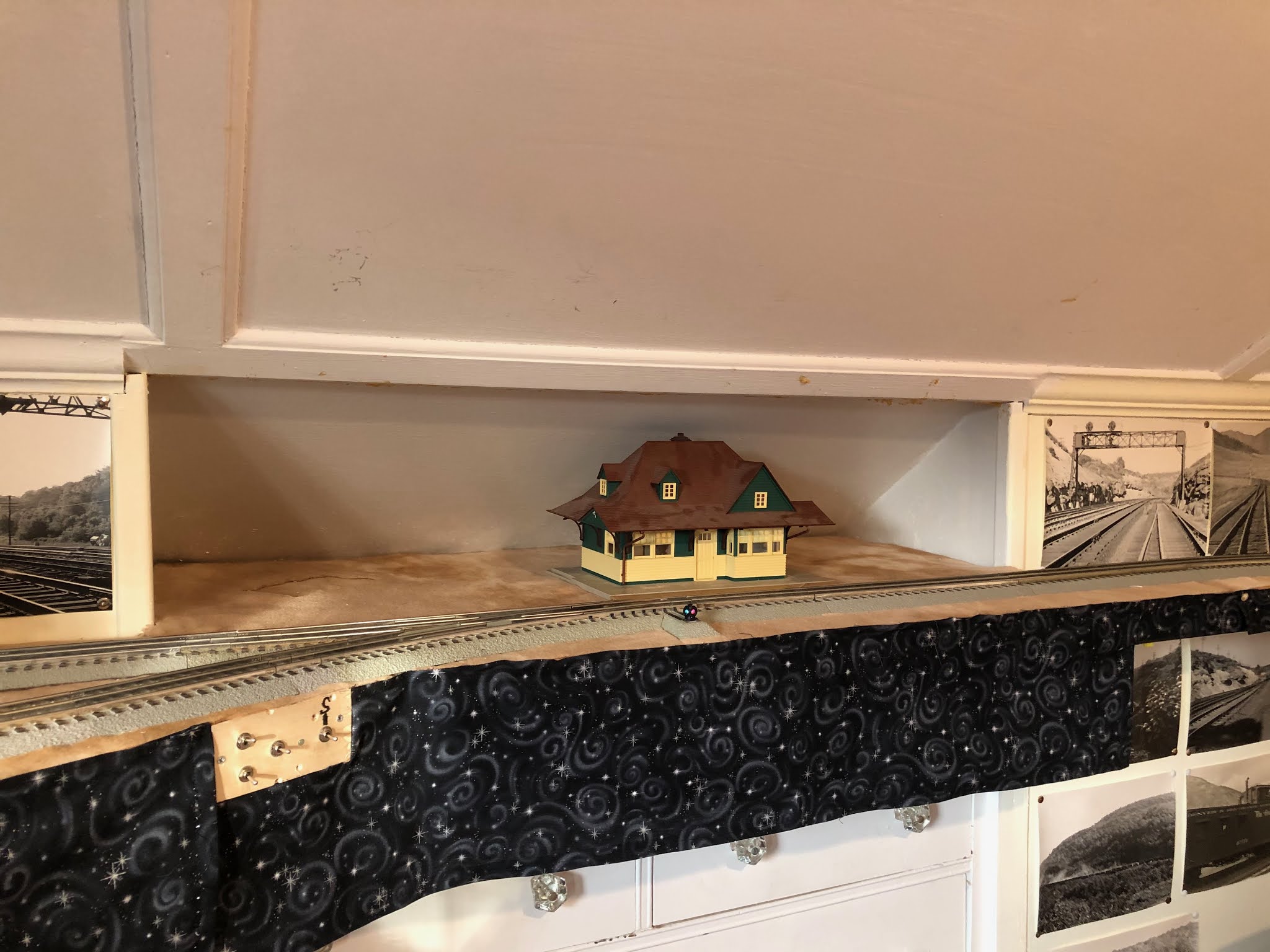
The old Depot has a suitable location:


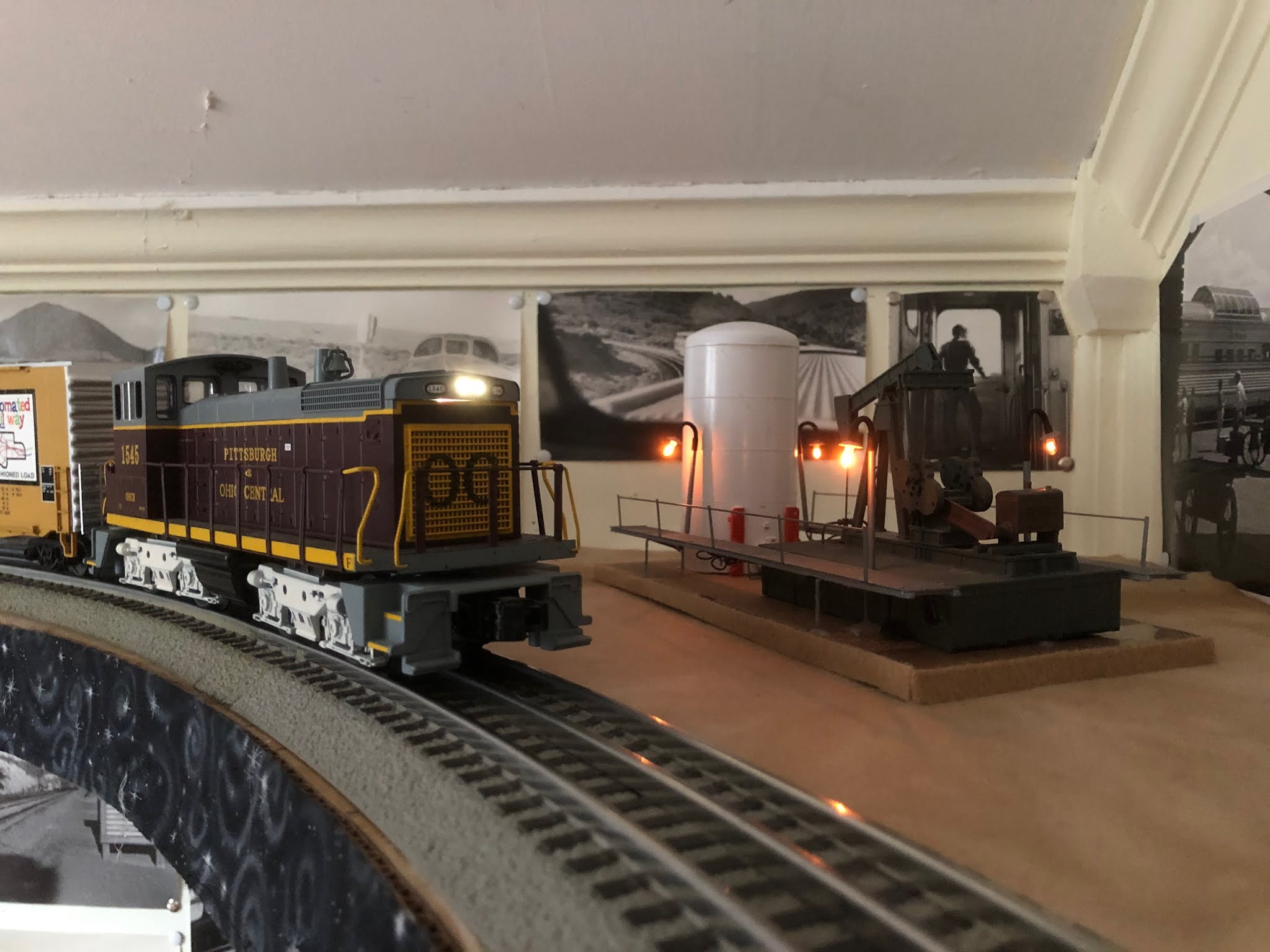
The Northwest corner now has a [developing] vignette, an oil well with operating pump jack:


Monday, July 27, 2020

Yet Another Tweak

I work towards the essence of the switching model railroad, one element of which is aesthetics.While in the real world railroads appear small and skinny and spread thin across the landscape, because of extreme space limitations model track-plans tend to  instead have a busy appearance. To reduce busy-ness I set about  simplifying the PER track-plan to eliminate all non-essential trackage. This project dovetails with another aesthetic concern, the need to maintain a "shelf" model railroad wherein the operator is always close to the train, "trackside" if you will. This lends believability to the model as being a miniature real train.

So. This was the recent view looking towards the West End:
Showing the run-around siding and a crossover.


I went to work and this was the first result:
     

Run-around gone, West End sidings now with
entry from the West and
the benchwork ("shelf")
narrowed by 6"

Before:


After:


Hmmm. Why not simplify by eliminating the second siding in favor of  lengthening the main siding? Could space be found to accommodate a [longer] siding? Well, here it is:


It works.
From right to left, tank car spot for PVA (polyvinyl acetate), box car spot for loading paint (behind the main structure), tank car spot for acrylic resin, covered hopper spot for titanium dioxide (white pigment) and storage for two cars off-spot.


Eliminating the run-around also permitted narrowing the benchwork at the East End from this (previous):


To this (now):


By now just six track switches enable full operations on the Plywood Empire Route. While I've not seen a prototype short line railroad that uses shove-moves on it's "mainline" such an operation is certainly possible and for a model railroad it permits and encourages a lean streamlined track-plan wherein the essence is promoted and distracting clutter is minimized. Or so it seems to me. I leave the Reader to make their own judgement.

Saturday, July 18, 2020

Another Track-Plan Tweak

This was the most recent West End configuration. I determined that I wanted less benchwork encroachment into the room in the Southwest corner. To that end I reduced the length of the runaround/passing siding/engine escape, allowing the curve to move Southwest by about seven inches, in turn permitting the removal of that much benchwork.

How it was:


How it is now:


A better view of the Paint Factory:
Notice Paint Factory
sidings from both directions.

The runaround-siding now:


The siding no longer holds and entire train so if the locomotive needs to be at the other end of the train a saw-by operation must be performed, something the prototype did for the same reason: siding to short for the train. Not usually a problem on the Plywood Empire Route because I have reverted to the operating scenario wherein trains moving toward Interchange do so as shove moves. An old   ex-Conrail Hack is hung on the rear-end to provide a safe riding platform so the Conductor is able to be lookout during shove-moves. 

Saturday, April 11, 2020

Track-Plan Tweak


The new West End:
There are spots for 6 cars now.


At the East End looking West:
Showing the new passing siding.

At the West End looking Southeast:


Connecting it together:


For reference, the East End:


Switching work at the West End can be a bit complex and can take some time:


The setup for switching the East End:


That's it for today.


Sunday, June 23, 2019

Improved Operations on the Plywood Empire Route

Jan's brother Jack died recently and I wanted to remember him. I used to frequently go for a morning walk at Upper St Clair Boyce Park and then go to Jack's apartment and take him shopping. So I would be thinking about him while I walked. A railroad runs along one edge of the park and I would sometimes see a local switching job passing by. The Pittsburgh&Ohio Central  shortline railroad runs from Carnegie to Canonsburg. I obtained this O scale model of one of their engines and yes, I think of Jack every time I run that engine:

An MTH model of the EMD SW1500 switch engine.
808 units were built between June, 1966 and late 1974.

This model is fully electronic (engine sounds as well as bell and whistle) and has precision can motors with electronic governors (speed control). What this means is that even at very slow speeds motion is as smooth as silk, right down to a slow [scale] walk. Thus switching moves (pulling and setting out cars on sidings) is much more realistic than with the old Lionel postwar engines which are basically very rugged toys. There is a problem though. Lionel type couplers, although patterned after real knuckle couplers, require a lot of force to couple. So one basically has to ram two cars together for them to couple, not a very realistic operation. What I needed for slow speed coupling was brakes to hold one car in place while another car is backed against it. So I assembled several of these devices:


The basic bit is a Circuitron Tortoise slow-motion switch machine usually seen on HO pikes. It actuates a brass tube which is fitted inside a larger piece of tubing.  Installed in the roadbed adjacent to an electromagnetic uncoupler it looks like this:

In the lowered position.

In the raised position.


Here it is seen in position to stop a car from moving while a car comes from the left and pushes the coupler slowly closed until it locks. No more crashing cars together! Switching is now much more like the real thing on the Plywood Empire Route.

Video of the gadget:


Tuesday, November 13, 2018

TOYS

 With our move to the Berkshires the second floor of our Cape Cod is entirely devoted to toys: Jan's sewing room and my train room.  I have been a Railfan all my life and have always been interested in model railroads and now we finally have a space where I can pursue my interest.

I am what is known in the biz as a "high railer", using O gauge Lionel-style track and scale or near-scale rolling stock in a semi-realistic scenic setting. Rather than a layout with concentric loops of track with several trains madly screaming about my track plan and operating scheme mimics an actual railroad, with the purpose being to transport goods.

O scale is ¼" to the foot or 1/48 scale so it takes up a lot of space. Most modelers use HO scale which is 1/87 proportion but that stuff is too small for my Senior eyes so O scale it is. What this means is that in a 13'X14' room the track plan is necessarily quite simple: a loop around the perimeter of the room with sidings for several industries. An interchange track (a connection with the outside railroad world) is through a tunnel into a corner of Jan's sewing room. The operating scheme is the delivery of loads and empties to the on-layout industries with the pickup of loads and empties from those industries being delivered back to Interchange where they are picked up by virtual trains to be delivered into the virtual outside world. This is the essence of any model railroad operating scheme.

It has been said that a picture is worth a thousand words so here are some pics :~)

Don't forget that clicking twice on a pic enlarges it greatly.

A bit about construction:


 First is Benchwork. I used a tried&true
method: ¼" plywood decking resting on
1X2 joists which rest in turn on
beams made of screwed&glued
1X3 with 1X2 flanges. Strong, lightweight
and easy to modify. 


 These unrealistically sharp toy-train
90deg corner curves were hidden by
mountains.
That was the first day of operations.


Another tried&true technique:
hot glued cardboard strips


Covered with plaster cloth
(the stuff Docs use to make casts)  


covered in turn with a modeling product
called "Sculptamold".


As it all looks today:

The pic third from extreme left is of the Grand Canyon train.
I once rode in the locomotive from GC to
Williams Junction and return. The pic second from left is
of a Santa Fe GP9, the engine I rode.

There was a.22 rifle above the Fireman-side
front-facing door. I learned what it was for when
a bull walked onto the track and the engineer had to bring
us nearly to a stop (open range so cattle everywhere). Blowing the whistle did no good. The fireman took down the gun, opened the
door in front of him and shot that bull several times.
The bull then ambled off the track, unhurt because
the ammo was, of course, birdshot and all it did was sting him. That particular bull
loved to bother the train.


 Grain elevator, Tipple and
[virtual] tank car unloading
facility. For years a tank car
was periodically delivered to
a team track siding in Somerset, Pa
where it's cargo would be offloaded
into tank trucks. I need an O
scale tank truck to complete
the scene.


Oil refinery and paint factory.
The refinery produces loads of
petroleum products. Loads of
solvents, resins and pigments
come in to the paint factory and
loads of paint leave in boxcars. 


 Track is Lionel Fastrack.
Scale size ties and tie spacing
with built-in "ballast".
Hard to not see that
unrealistic third rail
(the purpose of which is to
bring electric power to
the train, as a trolly-wire
would do) but that is what third-railers
do.


Mountains:

Ground cover is fleece
from Joanne :~)


The left pic is near Bennington Curve
close to the top of the Hill above
Horseshoe Curve.
The right pic is starting the climb
to Moffat Tunnel
West of Denver .


Riverside Geyser in the pic.
To the left a Pennsy freight after descending
the Hill to Altoona. Wreathed in brake smoke.


Now about those photos wallpapering the walls. Scenery on this pike is simple and largely symbolic/schematic and the photos are an important scenic element. They were taken over my childhood by my Dad and processed in his darkroom. Many of them I developed as I often helped in the darkroom.


Left center Mom and I in the Dining Car 
Christmas morning 1964.
Immediate right 4y old me at a train wreck!
Right of that Horseshoe Curve.
Bottom left a B&O Maple Sugar excursion
bound probably for Meyersdale, Pa, c. 1958
Top left two pics same excursion train
with an open gondola.


Bottom left is passing through
Island Park, Id a few miles from
West Yellowstone. 1960, the
last year the UP Park Special
ran to West. The other pic is of
the train standing in front of the dining
hall in West. We all got off the train
and walked in where breakfast was
laid out. The Conductor had come
through the train and taken our orders
earlier.
The railroad lantern belonged to either
my Grandad or his brother. They were both
Telegraphers on the PRR. 


 Center is a train climbing the Hill
above Horseshoe Curve. Pic to the right is in Cajon Pass
on the Santa Fe.
Bottom left is me filming a passing
UP Dome from another UP Dome.


Top right is the 2100 and 2124 doubleheading
on a Reading Ramble c. 1959.
Left center is a D&RGW Narrow Gauge
train 1954.Bottom left is the California Zephyr
along the Colorado River near it's headwaters.
Next is the D&RGW Royal Gorge....
in Royal Gorge. A 10min photo stop.
Next rightward is the Royal Gorge
somewhere near Tennessee Pass,
which until mothballing was the highest
mainline railroad pass in America.
Bottom right is me dangling my feet
over the rim of the Grand Canyon.
The PRR passenger train is stopped in Driftwood, Pa c.1955.
Top just left of center is a B&O excursion train
pulled by an EM1, their heaviest articulated
freight engine. Pic taken from an open gondola car c 1956.
You can see one person's goggles, a necessity
to keep coal fly ash out of one's eyes.


Dad's railroad clock at left.
Looking at San Fransisco Peaks
(Flagstaff, Az)
A tour train sitting at Grand Canyon.
Train schedule posted on the CG station wall.


Center is the UP 844,
a super-power 4-8-4 Mountain
class engine on a photo-run-by.
National Railway Historical Society 
convention excursion train
on Sherman Hill
(West of Cheyenne, Wy)
1963
To the right, 4y old me holding a miniature
lantern in Royal Gorge.
Left is Riverside Geyser.
Bottom center (small pic)
is us at the graves of
Stot, Scott and Wilson,
lynched in the Pleasant Valley
range war. Probably hung from
the trees in the background.


To the left of the tank car, Green River, Wy
with brace of E9s in front of the station, c. 1964
Immediate right taken on the PRR across the 
Allegheny River from the Woods.
Further right me looking out an open
vestibule door (top half of the door open).
My favorite way to ride a train.